


The Nordplus Higher Education development project “Traditions and Innovations in Baltic and Nordic Mathematics Education / 2025” (No. NPHE-2025/10040) concluded on 1 October 2026. Coordinated by Daugavpils University, the project was implemented in partnership with Riga Technical University, TTK University of Applied Sciences in Estonia, and Åland University of Applied Sciences. As the project came to an end, particular attention was given to student feedback and the role of the newly developed teaching materials in promoting more sustainable and inclusive higher education.
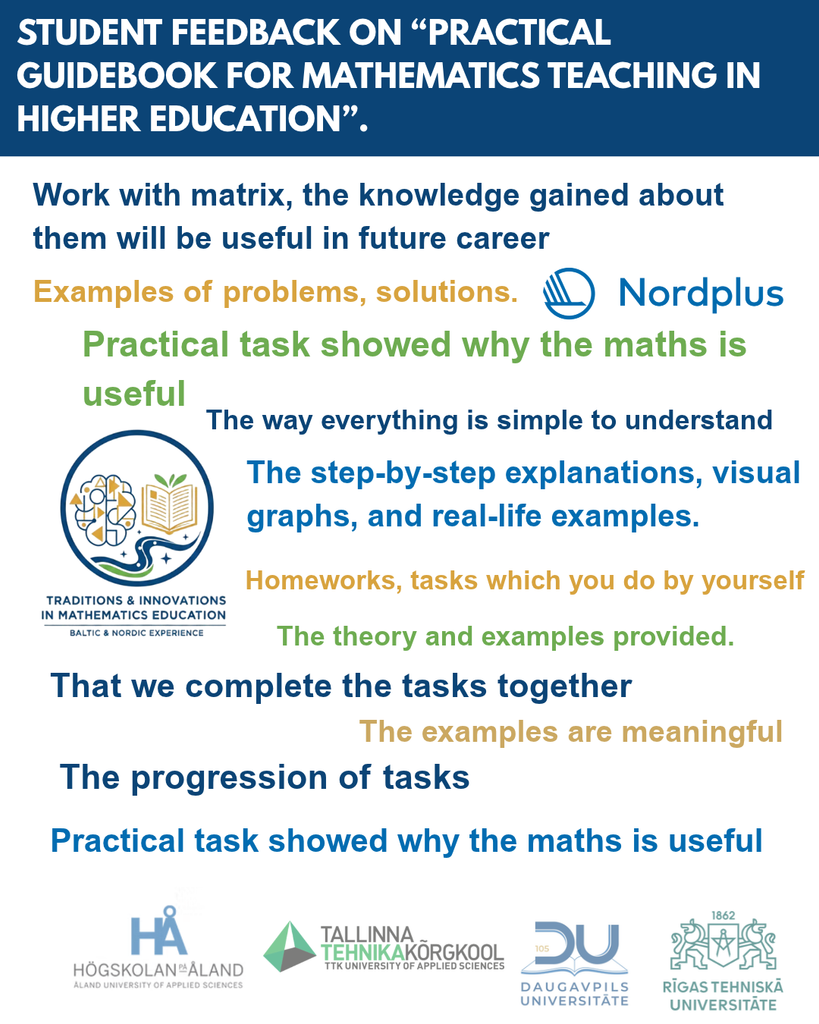
To gather students’ perspectives on the mathematical tasks developed during the project, an anonymous survey was conducted among 75 students. The survey explored the clarity, usefulness and suitability of the materials for mathematics learning. The findings indicate an overall positive response. 96% of respondents agreed that the language used in the materials was appropriate for higher education, 88% agreed that the tasks helped develop problem-solving skills, and 83% felt that the materials supported their understanding of mathematical concepts. In addition, 81% found the task instructions easy to follow, while 76% agreed that the tasks encouraged critical thinking. The survey also highlighted areas for improvement. Only 37% of respondents agreed that the materials sufficiently connected mathematics with real-life situations. In their open-ended responses, students suggested including more practical examples, additional explanations and concise summaries of key topics.
The project contributes to the priorities of the Nordic and Baltic region’s Vision 2030, particularly the green transition, social sustainability and competitiveness. One of its key achievements is the development of freely accessible digital mathematics teaching resources that can be shared and reused across higher education institutions. This approach supports more efficient use of educational resources, reduces reliance on printed materials and helps avoid duplication of development efforts. The project also makes an important contribution to social sustainability and equal access to education. The practical mathematics guidebook developed within the project includes exercises at three levels of difficulty, theoretical explanations, worked examples and solutions. These features accommodate students with different levels of prior knowledge and enable them to progress at their own pace. The materials are particularly valuable for students who cannot attend classes regularly due to health issues, work commitments or other personal circumstances. By providing opportunities for independent study and revision, they help reduce barriers to learning. Their availability in English also makes mathematics learning more accessible to international students.
Although the project has concluded, its outcomes will continue to support mathematics education beyond the project period. The freely accessible teaching and methodological resources, together with insights gained from student feedback, provide a valuable foundation for further developing mathematics education that is more inclusive, practice-oriented and sustainable.
Additional information:
Dr.paed. Liene Briede
Department of Education and Psychology
Faculty of Humanities and Social Sciences
Daugavpils University
liene.briede@du.lv


